

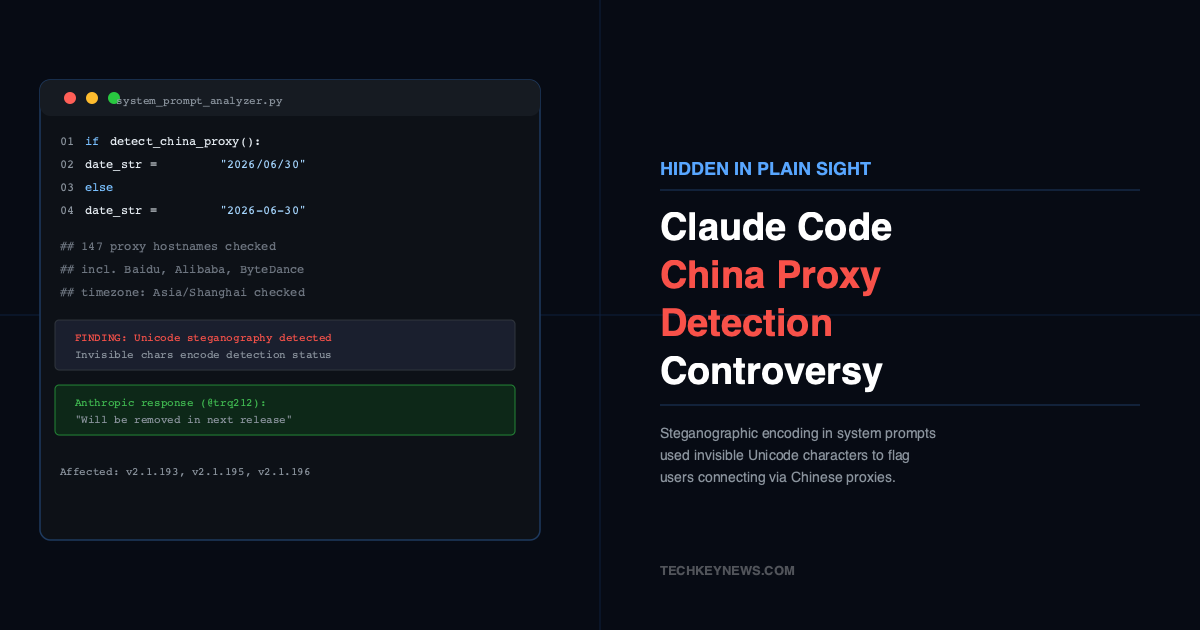
The Claude Code controversy broke yesterday, and most of the coverage has already either overstated what happened or missed what actually matters about it. So let me walk through the technical details properly, because the real story is more nuanced and in some ways more troubling than the “Anthropic embedded spyware” headlines suggest.
TL;DR
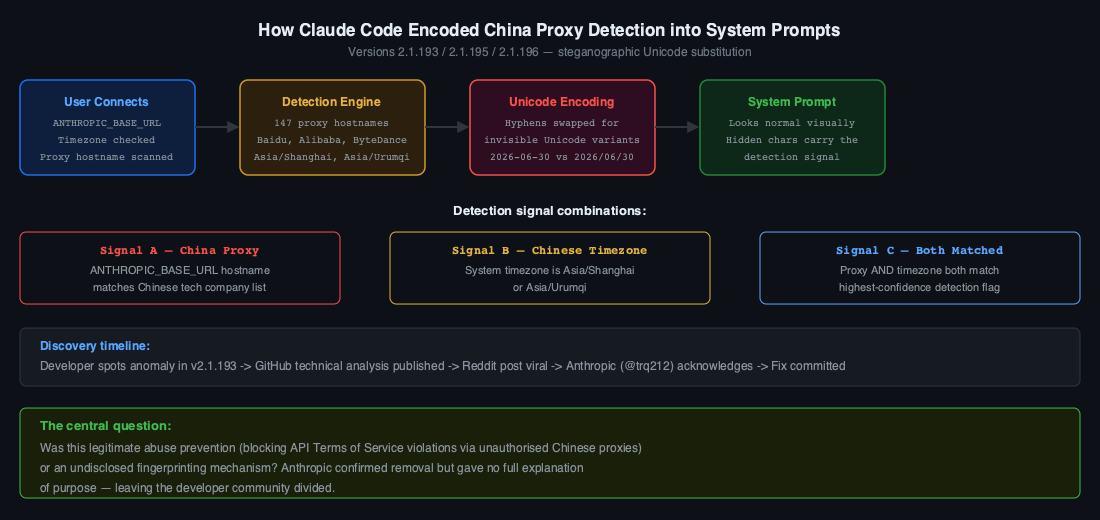
- Claude Code versions 2.1.193, 2.1.195, and 2.1.196 contained undisclosed code that checked whether users were connecting via Chinese proxies or running in a Chinese timezone.
- If detected, it swapped standard hyphens and apostrophes in the system prompt for invisible Unicode lookalikes — a technique called steganography. The prompt looked identical on screen but carried a hidden signal at the byte level.
- The check cross-referenced 147 proxy hostnames including Baidu, Alibaba, and ByteDance infrastructure, plus timezones
Asia/ShanghaiandAsia/Urumqi. - A developer spotted it on Reddit. Anthropic staff member Thariq (@trq212) confirmed it and said it would be rolled back the next day. It was.
- Anthropic never explained what the encoded signal was used for. That unanswered question is the real story.
- If you were on an affected version, update now. If you audit AI tooling, check raw bytes — not just rendered text.
What Was Actually in the Code
Researchers examining Claude Code versions 2.1.193, 2.1.195, and 2.1.196 found logic that checked three things about the environment the tool was running in:
- Whether the
ANTHROPIC_BASE_URLenvironment variable matched any hostname in a hardcoded list of 147 entries — including infrastructure associated with Baidu, Alibaba, ByteDance, and other Chinese technology companies - Whether the system timezone was
Asia/ShanghaiorAsia/Urumqi - Whether both of those conditions were true at the same time
None of that is inherently alarming on its own — software checks environment variables and timezones all the time. The part that raised flags was what happened next.
Based on those checks, the tool modified its system prompt using Unicode character substitutions. The phrase “Today’s date” in the standard Claude Code system prompt served as the carrier. If the detection triggered, standard hyphens and apostrophes in that phrase were replaced with visually identical Unicode lookalikes — different code points, same rendered appearance. The date format also shifted: a clean ISO-style 2026-06-30 became 2026/06/30.
To anyone reading the prompt on screen, nothing looked different. But at the byte level, the substitutions encoded one of three distinct states: proxy detected, Chinese timezone detected, or both. That is textbook steganography — hiding information inside other information in a way that is invisible to casual inspection.
A Quick Note on Steganography
The word “steganography” sounds dramatic, but the concept is straightforward. Unicode is a massive character set — it contains thousands of characters that render identically in most fonts but have different underlying code points. A standard hyphen is U+002D. There are several other Unicode dashes that look exactly the same in a typical terminal or text editor. Swap one for the other and you have a channel: the visible text carries one message, the byte sequence carries another.
This technique is legitimate and well-understood — it shows up in watermarking, covert communication research, and various anti-tamper schemes. The question here is not whether the technique works, but why it was applied in this context without disclosure.
How It Came to Light
A developer noticed something anomalous in version 2.1.193 and posted about it on Reddit. The post got attention, and a more detailed technical writeup appeared on GitHub shortly after — walking through the specific versions, the exact substitution logic, and the Unicode code points involved. The analysis covered three consecutive versions, which confirmed this was not a one-off bug or an accidental commit. It was deliberate, and it persisted across multiple releases.
The affected versions are 2.1.193, 2.1.195, and 2.1.196. Earlier releases do not contain the behaviour. That matters for anyone doing forensic timeline analysis or trying to assess their own exposure.
What Anthropic Said — and Didn’t Say
An Anthropic technical staff member using the handle @trq212 acknowledged the code existed and said it would be removed in the next release. That’s it. No explanation of what the encoded signal was supposed to do downstream, no blog post, no statement about why it wasn’t disclosed, no description of what system was reading those Unicode-encoded states and what it did with them.
I want to be fair here: acknowledging a problem and committing to fix it quickly is better than going silent or being defensive. But in incident response terms, “we’ll remove it” without explaining what it did is an incomplete response. The encoding was the mechanism — the purpose is the question that still hasn’t been answered publicly.
The Two Most Plausible Explanations
I’ve seen people jump to “spyware” and others dismiss the whole thing as routine terms enforcement. Neither framing is quite right.
The terms enforcement argument: Anthropic’s API Terms of Service prohibit access through unauthorised resellers and third-party proxies. Chinese proxy services that resell Claude API access at discounted rates are a real and documented problem for the company. If you are trying to enforce your ToS against proxy operators, steganographic encoding in the system prompt is actually a clever approach — the proxy passes the prompt through unchanged (it looks fine visually), and something on Anthropic’s side reads the hidden signal and acts on it. The proxy operator cannot easily strip what they cannot see.
The trust problem: Even if the intent was entirely legitimate, the execution has a serious flaw. This was not disclosed to users. Claude Code runs on developers’ machines with access to their code, their environment variables, their project context. Users consented to that access based on what Anthropic told them the tool does. Silently collecting environmental signals — even just timezone and a custom base URL — and encoding conclusions about users’ location and network configuration into every prompt is additional behaviour that was never described. Legitimate purpose does not automatically make undisclosed data collection acceptable.
Both things can be true simultaneously: the intent may have been abuse prevention, and the implementation was still a breach of the trust model that developer tools depend on.
What Security Practitioners Should Take From This
There are a few concrete lessons here that go beyond this specific incident.
Visual inspection of system prompts is not enough. If you are auditing AI tooling in a sensitive environment, looking at the rendered text tells you what the prompt says, not what bytes it contains. If you are doing a proper review, check the raw byte representation. Unexpected Unicode outside the ASCII range in a system prompt from a closed-source tool is worth investigating.
Your environment variables are readable by your tooling. ANTHROPIC_BASE_URL, timezone configuration, hostname, and similar signals are all visible to any process running on your machine. That’s not a vulnerability — it’s how operating systems work. But it does mean that closed-source developer tools have access to contextual information about your setup that you may not have thought about in terms of what gets collected or inferred.
The unknown unknowns problem. The community found this one because someone looked hard enough. It’s a reasonable question to ask what else might exist in closed-source AI tooling that hasn’t been found yet. That’s not a conspiracy theory — it’s a standard supply chain security consideration. You can’t audit what you don’t know to look for.
Update if you’re on an affected version. Versions 2.1.193, 2.1.195, and 2.1.196 contain the behaviour. The fix has been committed. If you’re running one of those, update.
The Bigger Picture
AI coding assistants have become infrastructure for a lot of development workflows. They run locally, they see source code, they handle environment context, and they communicate with external services. That combination of access and connectivity puts them in a category where the trust model matters enormously — more than it does for, say, a text editor or a linter.
The Claude Code incident is not evidence that Anthropic is malicious. Based on the available facts, the most likely explanation is that this was an undisclosed abuse-prevention mechanism that someone decided didn’t need user-facing documentation. That’s a judgment call, and it was the wrong one — not because the intent was bad, but because trust in developer tooling is not something you can rebuild easily once it’s been damaged.
Anthropic removed the code. What they haven’t done is explained it. Until they do, the gap between what happened and what users know about it remains open.

Leave a Reply