

In boardrooms across America, hiring managers believe they are onboarding talented remote developers. In reality, some of those developers are North Korean government operatives, funnelling their salaries back to Pyongyang to fund weapons of mass destruction. This is not a hypothetical scenario — it is happening right now, at scale, and nearly every Fortune 500 CISO interviewed on the subject has admitted to hiring at least one.
The Operation: A State-Sponsored Employment Fraud
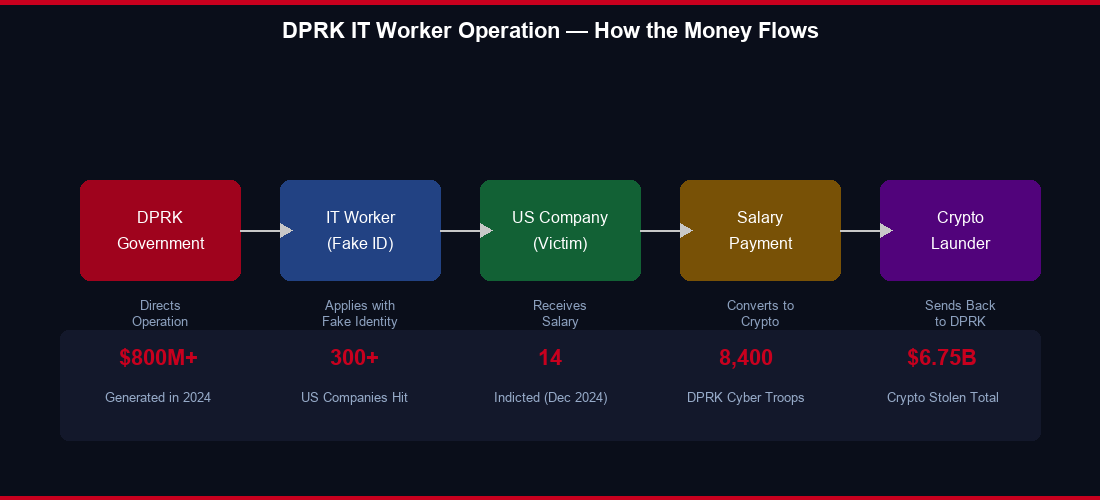
The Democratic People’s Republic of Korea (DPRK) runs a sophisticated, state-directed programme in which thousands of trained IT workers are deployed overseas — primarily based in China and Russia — to fraudulently obtain remote employment with Western companies. Using stolen or fabricated identities, they pose as South Korean, Chinese, Japanese, or Eastern European developers, pass technical interviews, and collect salaries that are routed back to the Kim regime.
The operation is not ad hoc. Internal slide decks seized by investigators coach operatives on resume writing, job platform tactics, interview preparation, and how to use Google search operators to find targets in specific regions. Workers are assigned monthly revenue quotas — some ordered to earn at least $10,000 per month per operative.
The Numbers: A Billion-Dollar Pipeline
The financial scale of this operation is staggering and growing every year:
- $800 million+ generated by DPRK IT worker schemes in 2024 alone
- $6.75 billion in cumulative cryptocurrency stolen by DPRK cyber actors
- $2.02 billion in crypto stolen in 2025 — a 51% increase year-on-year
- 300+ US companies infiltrated, including multiple Fortune 500 firms
- 8,400 personnel working in DPRK cyber divisions as of 2024, up from 6,800 in 2022
- $17 million funnelled through a single laptop farm operation run by one US facilitator
The US Department of Justice’s December 2024 indictment of 14 North Korean nationals revealed that conspirators in a single six-year operation generated at least $88 million. The money does not stay in the operatives’ pockets — it flows through cryptocurrency exchanges, Chinese banks (at least 19 identified), OTC traders, and mixing protocols before being converted to fiat currency and delivered to the regime.
How They Get Hired: The Full Attack Chain
Understanding how DPRK operatives breach corporate hiring pipelines is essential for defenders. The attack chain has several distinct phases:
1. Identity Construction
Operatives build convincing false identities using stolen US persons’ data, fabricated credentials, AI-generated profile photos, and legitimate-looking GitHub and LinkedIn profiles. In some cases, real US citizens are recruited as unwitting fronts — offered cash to lend their identity to what is described as a “stealth startup.”
2. Application & Interview
Job applications are submitted via mainstream platforms. During video interviews, operatives use Google Voice numbers matching the persona’s claimed nationality and may use deepfake or pre-recorded video to avoid live face exposure. They are technically competent — they pass coding challenges and technical assessments because many are genuinely skilled developers.
3. Laptop Farm Infrastructure
When hired, the company ships a laptop to what appears to be a US address. That address is actually a laptop farm — a residence or storage facility run by a US-based facilitator who installs remote desktop tools, proxies the connection, and forwards the machine’s traffic to the actual operative sitting in China or elsewhere. Investigators have searched 29 known laptop farms across 16 US states.
4. Access, Exfiltration & Extortion
Once inside the network, operatives collect salaries — but also harvest credentials, session cookies, source code, and sensitive data. In multiple documented cases, when companies attempted to terminate the worker, the operative threatened to leak stolen proprietary source code unless an extortion payment was made. This second-stage monetisation turns a hiring fraud into a full ransomware-adjacent incident.
Real Cases: DOJ Indictments and Arrests
US law enforcement has moved aggressively against both the North Korean operatives and their domestic enablers:
- December 2024 — DOJ indicts 14 North Korean nationals for a six-year scheme generating $88 million across hundreds of companies
- January 2025 — Indictment of North Korean nationals Jin Sung-Il and Pak Jin-Song along with facilitators in Mexico and the US; 64 companies defrauded
- Christina Marie Chapman (Arizona) — Sentenced to 8 years in federal prison for running a laptop farm that served 300+ US companies and generated $17 million for the DPRK over three years
- Matthew Isaac Knoot (Nashville) and Erick Ntekereze Prince (New York) — Both sentenced to 18 months in prison for hosting laptop farms at their residences
- Zhenxing “Danny” Wang (New Jersey) — Indicted for a scheme involving 80+ stolen US identities, 100+ companies, and $5 million in revenue; sentenced to 92 months
- State Department reward — Up to $5 million offered for information on DPRK IT worker networks
Evolving Tactics: 2025 and Beyond
The threat is not static. Microsoft’s June 2025 Jasper Sleet report and research from Okta, Mandiant, and others document a rapid evolution in tradecraft:
- Reduced reliance on laptop farms — operatives now abuse legitimate remote access tools and disable SASE solutions (Zscaler, Netskope) to create permissive environments
- Expansion beyond tech — 50% of targeted organisations are no longer technology companies; finance, healthcare, and public administration are now primary targets
- Global reach — 27% of targets are now outside the United States; UK, Germany, Australia, and Japan are active fronts
- Cybersecurity roles targeted — DPRK agents now specifically seek security engineer and SOC analyst roles to gain privileged visibility into defensive infrastructure
- Female personas introduced — to bypass behavioural pattern detection that flagged predominantly male profiles
- AI-enabled tools — custom software to generate deepfakes, manage multiple personas simultaneously, and automate job applications at scale
- Contagious Interview — a related operation where DPRK actors pose as recruiters to trick real job seekers into downloading malware during fake technical interviews
Red Flags: How to Spot a DPRK Worker in Your Hiring Pipeline
The FBI, CISA, and private researchers have documented consistent indicators. HR, IT security, and hiring managers should watch for:
- 🚩 Refusal of live video — persistent technical issues with camera or microphone during multiple interview rounds
- 🚩 Timezone inconsistencies — active login times incompatible with the candidate’s stated location
- 🚩 Impossible travel detections — rapid authentication from geographically impossible locations (Western country → China within minutes)
- 🚩 Laptop delivery to unusual address — company-issued hardware shipped to a residential address with no verified occupancy
- 🚩 Reluctance to use company device management — resistance to MDM enrollment or endpoint detection agents
- 🚩 Multiple job personas — same writing style, GitHub activity pattern, or IP address across multiple candidate profiles
- 🚩 Staffing agency referral with thin vetting — DPRK workers frequently enter through third-party staffing companies
- 🚩 Payment to unusual accounts — requests to be paid via cryptocurrency, foreign accounts, or third-party payment apps
What To Do If You Suspect You Have One
The FBI’s guidance is clear: do not confront the employee or tip them off. Past cases show that when operatives sense detection is imminent, they exfiltrate data immediately and initiate extortion demands. Instead:
- Escalate immediately to your Security and Legal teams
- Preserve all evidence — access logs, communication records, device activity
- Engage a forensic incident response team before any offboarding action
- Report to the FBI’s Internet Crime Complaint Center (IC3) and notify CISA
- Conduct a full credential rotation for any systems the individual accessed
- Review for lateral movement and data exfiltration indicators going back to the hire date
Sanctions Risk: Your Company Could Be Liable
This is not just a security problem — it is a legal one. Paying salary to a North Korean national, knowingly or unknowingly, violates US and international sanctions. The company itself, not just the worker, bears legal exposure under OFAC regulations. Several companies have already faced regulatory scrutiny after discovering they had employed DPRK-linked workers.
The US Treasury has sanctioned facilitators, front companies, and banks involved in laundering proceeds. The DOJ’s DPRK RevGen: Domestic Enabler Initiative, launched in March 2024, specifically targets US persons who — knowingly or unknowingly — enable the scheme.
Conclusion: Your Hiring Pipeline Is an Attack Surface
The DPRK IT worker programme represents a new class of threat that sits at the intersection of nation-state espionage, financial crime, and insider threat. It is not a vulnerability in your firewall — it is a vulnerability in your HR process.
With nearly every Fortune 500 CISO acknowledging at least one successful infiltration, this is not a niche concern for government contractors. It is a mainstream enterprise risk. Organisations that treat their hiring pipelines with the same scrutiny they apply to third-party vendor access will be far better positioned to detect and eject these operatives before the damage is done.
If you suspect your organisation has been affected, contact the FBI IC3 at ic3.gov or reach out to CISA at cisa.gov/report.


Leave a Reply